Monitoring and field equipment.
Developing an alternative to thermoelectric units and small combustion generators for remote site loads.

Layered solid oxide cell assembly
A static diagram is shown while the interactive model is unavailable.Serenity Power is developing compact solid oxide fuel-cell systems for remote industry. Designed to use natural gas or hydrogen, starting with small power needs at oil and gas sites.
Solid oxide fuel cells generate electricity electrochemically. Serenity’s design combines thin electrodes on a metal support with carbon-resistant electrode materials, aiming to shorten start-up and simplify fuel processing.
Read the research backgroundA useful power system needs more than a high-performing cell. Our development work brings cells, stack architecture, fuel handling and controls together, with manufacturability and supplier integration in view.
The development programme announced with NGIF Accelerator in April 2026 starts with a 100 W prototype and planned field testing in Alberta. Those trials are intended to inform larger systems of up to 1 kW.
Efficiency, start-up time, durability, fuel compatibility and installed cost must be validated at system level. Development targets are not verified field results.
Our first market is small power needs in remote oil and gas operations, where a grid connection may be impractical and fuel is already available. Larger industrial uses are a longer-term direction.
Developing an alternative to thermoelectric units and small combustion generators for remote site loads.
Future systems could serve remote utilities and microgrids as output, durability and integration are validated.
An expansion pathway for the platform after smaller systems establish performance in the field.
Applications are development priorities, not current product specifications. Fuel quality, treatment requirements, duty cycle and installation requirements need project-specific assessment. All 3D models here are conceptual.
Serenity’s existing site presents the following design targets and illustrative comparisons. They are not verified field results; assumptions and operating conditions require confirmation.
| Feature | Diesel | Conventional SOFC | Serenity target |
|---|---|---|---|
| Efficiency | 20–30% | >60% | >60% target |
| Start-up | Seconds | 3 hours | <15 minutes target |
| Volume (300 kW design) | 15 m³ | 20 m³ | 1 m³ target |
| Fuel | Diesel | Limited | Natural gas, hydrogen, biogas |
| Emissions | CO₂ / NOx / SOx | Low | Lower-emission objective |
Published design targets and comparison estimates, not validated specifications. The source does not provide a full comparison methodology; results depend on fuel, load, operating conditions and system boundaries. View original context ↗
Serenity’s technology builds on research at the University of Toronto. Recent financing supports prototype engineering and planned demonstrations.
Closed April 2026, led by Avatar Ventures, to advance prototypes and initial field demonstrations.
Read the financing announcement$231,792.53 awarded in April 2026 for prototype development and planned field testing.
Read the NGIF announcementAnnounced April 2026 to support the design, build and testing of the first integrated prototype.
Read the Alberta Innovates announcementThe company has announced letters of intent for pilot deployments. These indicate early commercial interest, not purchase orders or completed pilots.
Our objective is to reduce fuel use and emissions in suitable on-site applications. The result depends on the fuel supplied, the equipment displaced and how the system is operated.
Natural gas, hydrogen and renewable fuels have different composition and upstream footprints.
Compare systems at the same electrical load, duty cycle and useful energy output.
Natural gas produces CO₂. Hydrogen produces no CO₂ in the fuel-cell reaction; its production and delivery still matter.
Measured field performance is needed before publishing site-specific savings.
The existing Serenity site presents modeled estimates of 8 tonnes of CO₂ per unit per year and 77% fuel savings versus diesel, a noise target below 40 dB at one metre, and an illustrative 1,000-unit scenario of 8,000 tonnes of CO₂ avoided and 1,700 equivalent cars per year. These are modeled figures and targets, not measured results; the source does not specify the assumptions or methodology needed to validate them.
These are development objectives, not measured emissions reductions or guaranteed fuel savings. Renewable natural gas and biogas are not carbon-free at the point of use.
A Canadian team connecting fuel-cell research, product engineering and commercialization, with operations in Toronto and Calgary.

Co-founded Serenity to bring fuel-cell research into industrial use.

Co-founder with chemical and mechanical engineering training at the University of Toronto.

Leads technology and product development, from stack design to manufacturing and supplier integration.

Fuel-cell researcher with a PhD from the University of Toronto.
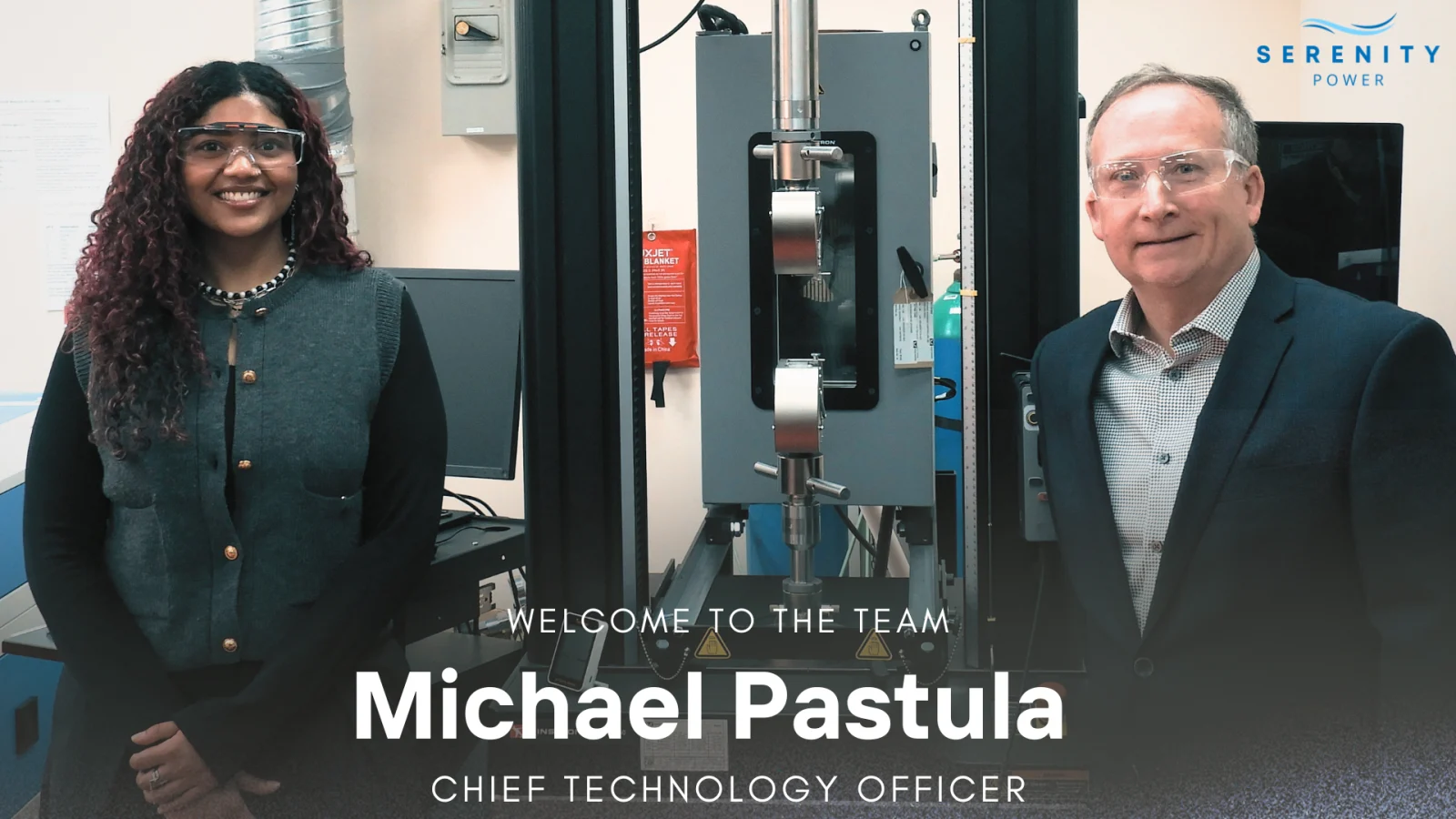
Michael Pastula joins as CTO to lead technology and product development toward commercialization.
Read press releaseAn oversubscribed $1,165,000 CAD round led by Avatar Ventures brings secured capital to $2 million CAD for prototypes and commercial pilots.
NGIF Accelerator awards $231,792.53 for prototype development and field testing at natural gas, remote and industrial sites.
Alberta Innovates awards $300,000 to advance the compact, fuel-flexible power system.
CBC profiles co-founder Aleisha Cerny as Alberta’s oil and gas sector anticipates needing 72,000 workers by 2035.
BetaKit covers the $1.16 million CAD round funding prototype development, field demonstrations and team growth.
Altitude Accelerator follows Aleisha Cerny’s journey from engineering research to fuel cell entrepreneurship.
Aleisha Cerny discusses replacing diesel with fuel cells that use existing infrastructure.
Serenity Power chooses Calgary as a base to scale its compact fuel cell technology.
Serenity Power receives $100,000 from The Firehood’s angel investors at the Elevate Women+ Pitch Prize.
Aleisha Cerny reflects on winning $100,000 at Montreal’s Startupfest and building Serenity Power.
University of Toronto research led by Professor Olivera Kesler underpins Serenity Power’s compact fuel cell technology.
Tell us where you operate, what fuel is available and the power your equipment needs. We welcome conversations with industrial operators, pilot collaborators and strategic partners.
For investment, engineering or manufacturing enquiries, contact the team directly.
If the form is unavailable, email contact@serenitypower.ca directly.