
Aleisha Reese Cerny
Background
MASc, Mechanical & Industrial Engineering, University of Toronto. Leads the company’s move from university research to commercial pilots. Source ↗

Layered solid oxide cell assembly
Serenity Power is developing compact fuel-cell systems for remote industrial equipment—starting with monitoring and instrumentation at oil and gas sites.
Conventional solid oxide cells use thick ceramic electrodes that are slow to heat. Our approach places a thin electrode on a metal support for faster start-up, with a carbon-resistant composite that protects the electrode from fouling in hydrocarbon fuel—aiming to reduce external fuel processing.
Builds on research in Professor Olivera Kesler’s laboratory at the University of Toronto. Intellectual-property and licensing details are shared in diligence. Source ↗
A field system depends on more than the cell. The defensible work is integration: cells into a stack, then fuel handling, thermal management and controls engineered together, with manufacturability and supplier integration in view.
We are developing a 100 W system now. Field validation is planned next, followed by development of systems of up to 1 kW. Larger systems depend on engineering, manufacturing, service and market validation.
3D models are conceptual and not to scale.
See current progress
Our first application is small, continuous power for monitoring, SCADA and instrumentation at oil and gas sites where gas is available and a grid connection is impractical.
Operators of remote wellsites, pipelines and gas facilities that need communications, sensors and control equipment running around the clock.
Small, steady electrical loads in the tens to hundreds of watts. Our first development system is sized at 100 W for this duty.
Thermoelectric generators, small combustion generators and solar with battery storage. Each is chosen for site conditions, and each involves trade-offs in fuel use, maintenance and seasonal output.
Serenity’s system is in development; how it compares on each factor will be established through field validation. Discuss a pilot
Later: once small systems are validated, the same platform could serve larger loads such as remote utilities, microgrids and industrial sites.

Performance has to be demonstrated at system level, at a real site. These are the questions our prototype and field programme are designed to answer.
Where the company stands today.
University of Toronto News reports the investment, and that pilot units are being deployed in Canada and Italy during 2026, with production anticipated in 2027. These are reported plans, not completed milestones.
U of T News ↗Innovate Calgary reports a paid pilot secured with a customer in Europe, first fuel-cell stacks and prototypes built at its Aerospace Innovation Hub, and a 100 W generator in development for SCADA and instrumentation. It also reports a US$5M seed round begun — a fundraising target, not capital raised.
Innovate Calgary ↗Leads technology and product development, including stack and system architecture and manufacturability.
ReleaseTo support design, build and testing of the first integrated prototype.
ReleaseU of T Engineering describes the research origin and a working 5 × 5 cm cell as of that date. A lab cell is not a validated system.
U of T Engineering ↗
A Canadian team connecting fuel-cell research, product engineering and commercialization, with operations in Toronto and Calgary.
MASc, Mechanical & Industrial Engineering, University of Toronto. Leads the company’s move from university research to commercial pilots. Source ↗

Co-founder. Chemical engineering degree and MEng in mechanical engineering, University of Toronto; PEY Co-op at Toronto Hydro. Source ↗

Fuel-cell engineer with experience in mechanical engineering, system development and scalable product design. Leads stack and system architecture and manufacturability. Release

PhD, Mechanical & Industrial Engineering, University of Toronto; part of the founding research team. Leads research and development. Source ↗
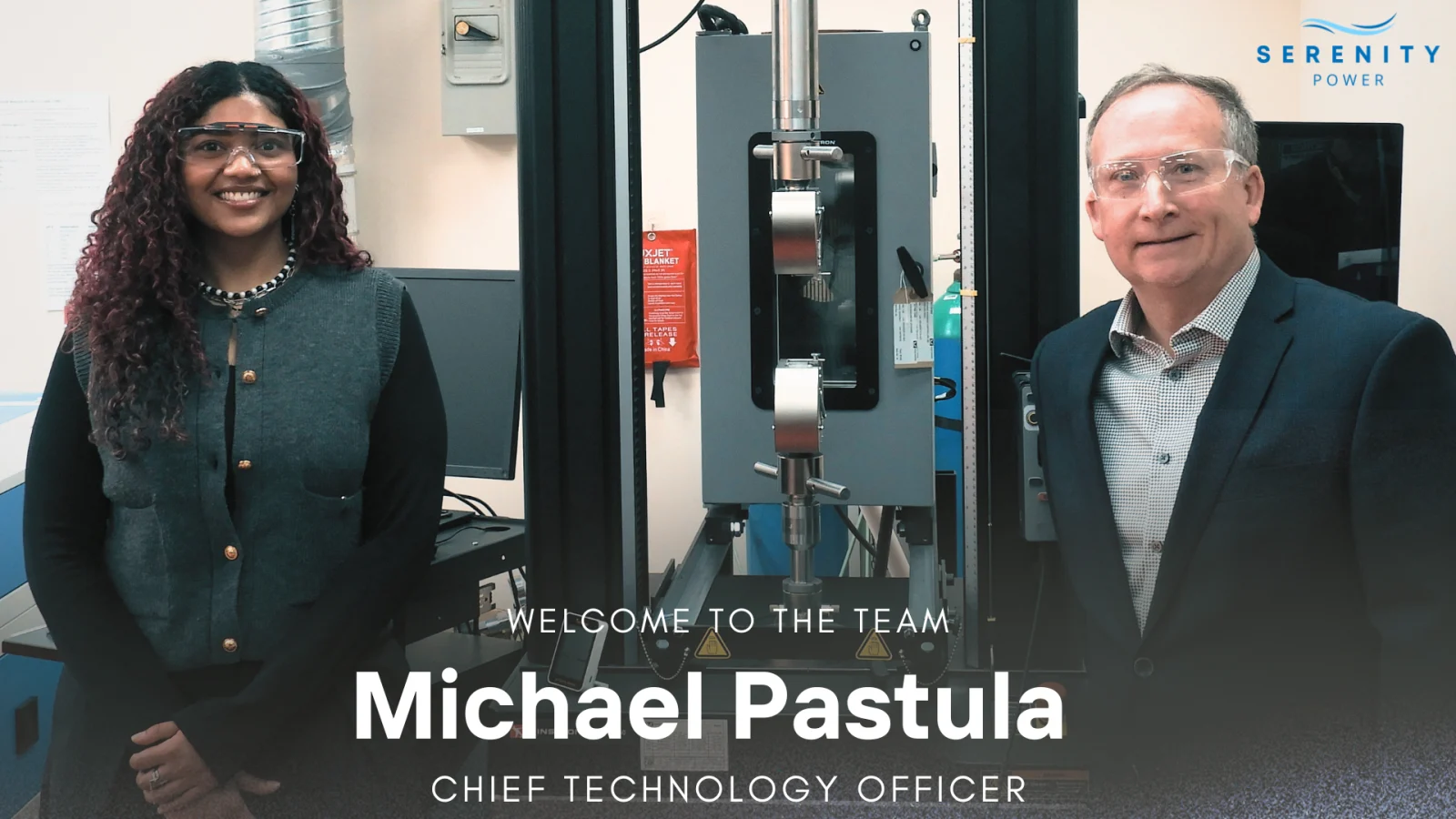
Michael Pastula joins as CTO to lead technology and product development toward commercialization.
Read press releaseAn oversubscribed $1,165,000 CAD round led by Avatar Ventures brings secured capital to $2 million CAD for prototypes and commercial pilots.
NGIF Accelerator awards $231,792.53 for prototype development and field testing at natural gas, remote and industrial sites.
Alberta Innovates awards $300,000 to advance the compact, fuel-flexible power system.
U of T News reports Serenity Power among the Catalyst Fund’s first investments.
Innovate Calgary reports first stacks built at its Aerospace Innovation Hub and a paid pilot secured in Europe.
CBC profiles co-founder Aleisha Cerny as Alberta’s oil and gas sector anticipates needing 72,000 workers by 2035.
BetaKit covers the $1.16 million CAD round funding prototype development, field demonstrations and team growth.
Altitude Accelerator follows Aleisha Cerny’s journey from engineering research to fuel cell entrepreneurship.
Aleisha Cerny discusses replacing diesel with fuel cells that use existing infrastructure.
Serenity Power chooses Calgary as a base to scale its compact fuel cell technology.
Serenity Power receives $100,000 from The Firehood’s angel investors at the Elevate Women+ Pitch Prize.
Aleisha Cerny reflects on winning $100,000 at Montreal’s Startupfest and building Serenity Power.
University of Toronto research led by Professor Olivera Kesler underpins Serenity Power’s compact fuel cell technology.
Investors can request materials or a meeting; operators can tell us about a site for a potential pilot.
Please don’t include confidential site data in a first message.
If the form is unavailable, email contact@serenitypower.ca directly.